Chapter 30 — Utility
Cambridge International AS & A Level Economics (9708) · Unit 7.1 · 4th edition coursebook
Learning objectives
- Define the meaning of total utility and marginal utility.
- Calculate total utility and marginal utility.
- Explain diminishing marginal utility.
- Explain the equi-marginal principle.
- Derive an individual demand curve.
- Evaluate the limitations of marginal utility and its assumptions of rational behaviour.
Key terms
- law of diminishing marginal utility
- As consumption increases, the satisfaction from consumption decreases.
- total utility
- The total satisfaction received from consumption.
- marginal utility
- The utility derived from the consumption of one more unit of the good or service.
- equi-marginal principle
- Consumers maximise their utility where their marginal valuation for each product consumed is the same.
30.1Utility and diminishing marginal utility
Earlier chapters derived a demand curve from a demand schedule but did not explain why a consumer is willing to buy more of a good as its price falls. The answer lies in the idea of utility — a measure of the satisfaction or happiness a person obtains from consuming a good or service. Utility theory assumes that this satisfaction can, in principle, be counted in units in the same way that the goods themselves can be counted.
Consider a hungry consumer buying slices of pizza. The first slice yields a large amount of satisfaction, and the consumer may be willing to pay a relatively high price for it. A second slice still adds satisfaction, but less than the first, so the consumer is willing to pay only a slightly lower price. A third slice adds less still. The reducing amount the consumer is willing to pay reflects the falling extra satisfaction received from each additional slice. The same logic explains why a shopper will quickly buy an item priced below what they expected (its utility exceeds the price asked) but walk away from an item priced above the expected price.
Total and marginal utility
Two measures of satisfaction are central to the analysis. Total utility is the overall satisfaction derived from consuming all units of a good over a given time period. Marginal utility is the additional utility derived from consuming one more unit. If a consumer gains ten units of satisfaction from one slice of pizza and fifteen units from two slices, then the marginal utility of the second slice is five units. Marginal utility is therefore the change in total utility caused by consuming one extra unit.
The law of diminishing marginal utility
The law of diminishing marginal utility states that, as consumption of a good increases, the marginal utility derived from each additional unit gets smaller. Total utility may still be rising — the consumer is still gaining satisfaction from the next unit — but it is rising at a slower and slower rate. This pattern is the reason a consumer is only willing to buy more of a good when its price falls: each successive unit is worth less to them than the one before, so price must fall to make further purchases worthwhile. Diminishing marginal utility therefore provides the underlying explanation for the downward-sloping individual demand curve.
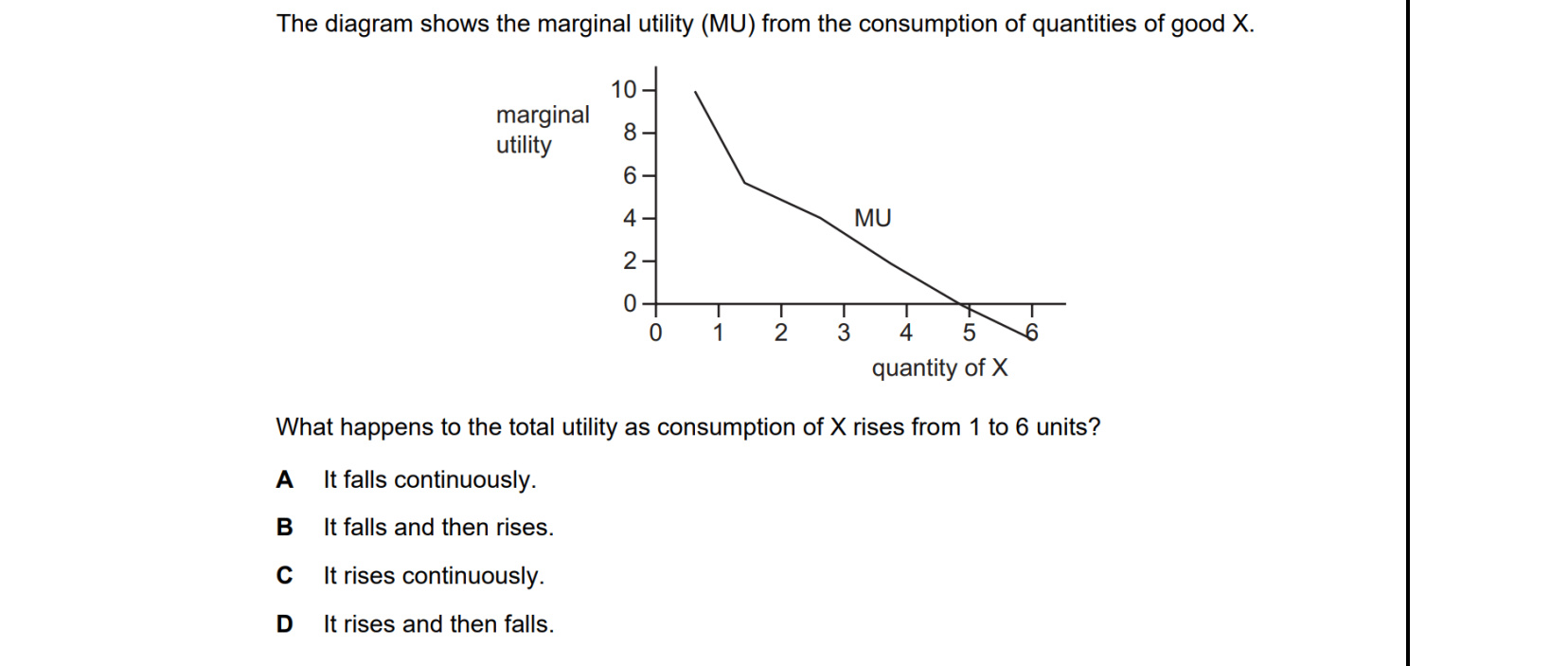
Total utility rises as long as marginal utility is positive and falls only when marginal utility is negative. The diagram shows MU starting at a positive value and falling through zero between units 4 and 5 into negative territory. So total utility rises up to the unit where MU = 0, then falls — it rises and then falls between 1 and 6 units.
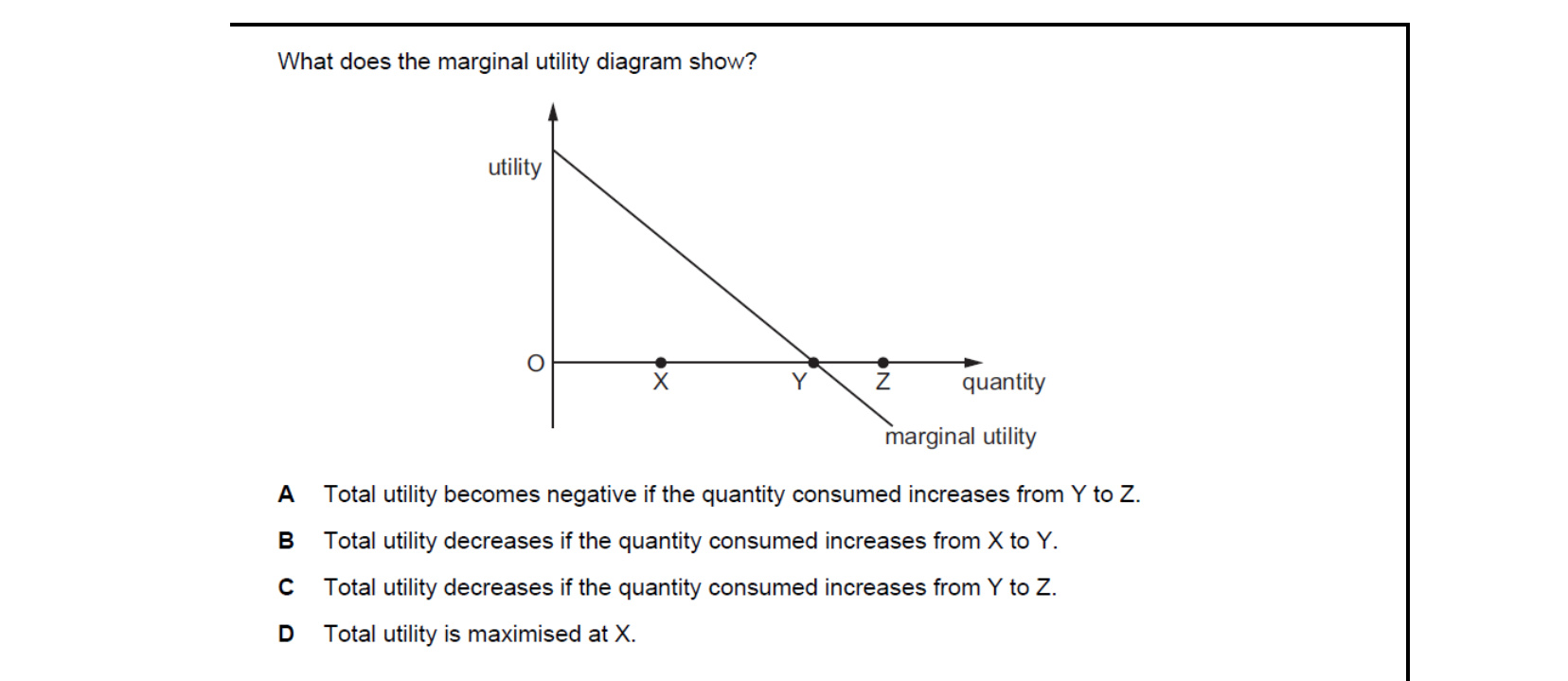
Total utility changes by the marginal utility of the next unit. The MU curve in the diagram cuts the quantity axis at Y (MU = 0) and then turns negative between Y and Z. Adding negative marginal utilities means total utility decreases as consumption rises from Y to Z, so the correct option is that total utility falls between Y and Z.
30.2The equi-marginal principle
A consumer rarely buys just one good. When income is divided between several products, the question becomes: how should a consumer allocate a limited budget so that total satisfaction is as large as possible? The answer is given by the equi-marginal principle.
A consumer is in equilibrium when it is no longer possible to switch spending from one good to another and raise total utility. Suppose product A yields marginal utility of ten units and costs $5, while product B yields marginal utility of twenty units and costs $10. The marginal utility per dollar (MU/P) is two for A and two for B; the consumer has nothing to gain by moving a dollar between them. More generally, consumer equilibrium occurs where:
MUA / PA = MUB / PB = MUC / PC = … = MUN / PN
where MU is marginal utility, P is price, and A, B, C, …, N are the different products. When this condition holds it is impossible to reallocate spending between any of the products and obtain more satisfaction. Income has been allocated in the way that maximises total utility.
Assumptions of the equi-marginal principle
The principle rests on three assumptions:
- consumers have limited incomes;
- consumers always behave in a rational manner;
- consumers seek to maximise their utility.
A simple numerical example illustrates the idea. Suppose products x and y cost $1 and $2 respectively and a consumer has $10 to spend. By calculating MU/P for each unit of x and each unit of y, the equilibrium combination can be found at the point where MU/P is the same for both goods and where total spending equals the budget. At that combination, total utility is as high as the budget allows; any other affordable combination would deliver less satisfaction.
Key concept link — Equilibrium and disequilibrium
The equi-marginal principle is used to determine whether or not consumer equilibrium is being achieved.
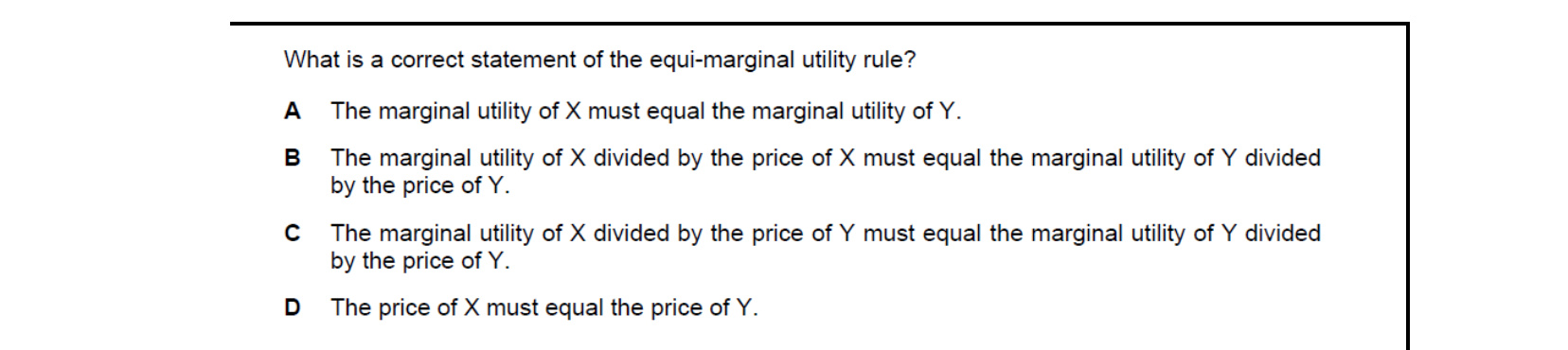
The equi-marginal principle says total utility is maximised when the last dollar spent on each good yields the same extra utility. Formally, MU of X divided by the price of X equals MU of Y divided by the price of Y. Equal marginal utilities alone are not enough — utilities must be scaled by price, which is the option that gives the correct rule.
30.3Derivation of an individual demand curve
Marginal utility analysis can be used to derive an individual's demand curve for a good. Begin at a position of consumer equilibrium, where MU/P is equal across all products being consumed. Now suppose the price of one good — call it y — falls, while the price of every other good and the consumer's income remain unchanged (see Figure 30.3).
Because the price of y has fallen, MUy/Py is now larger than the MU/P of every other good. The consumer can raise total utility by buying more y. As consumption of y rises, the law of diminishing marginal utility causes MUy to fall, which reduces MUy/Py back towards the common ratio. A new equilibrium is reached at a larger quantity of y. Total utility has increased.
Plotting the price of y against the quantity demanded gives two points on the individual's demand curve: the original price-quantity combination and the new lower-price, higher-quantity combination. Repeating the exercise for many price changes traces out a full downward-sloping individual demand curve. Because the underlying mechanism is the law of diminishing marginal utility, the analysis explains rather than merely asserts the negative relationship between price and quantity demanded.
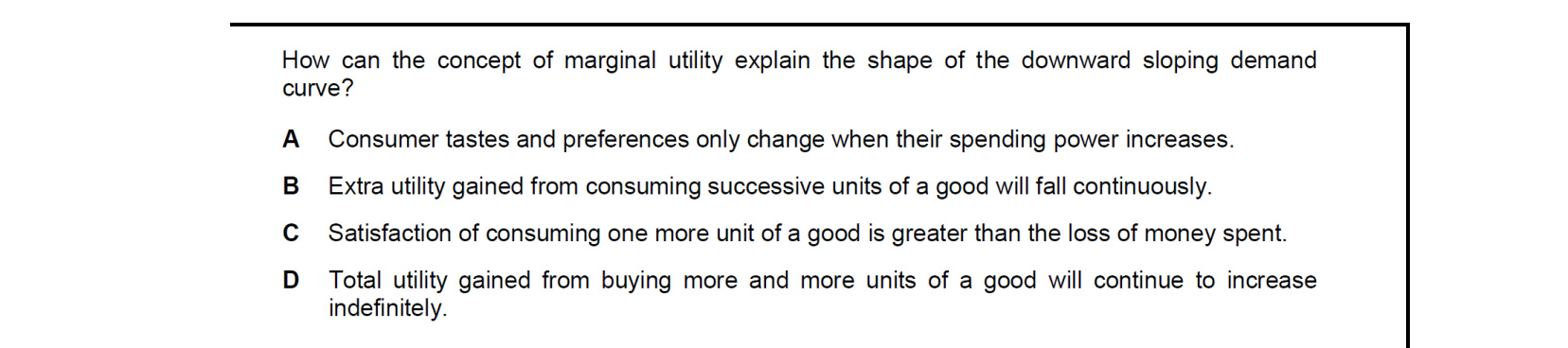
The downward-sloping demand curve reflects diminishing marginal utility: as more units are consumed, each successive unit yields less extra satisfaction, so consumers will only buy more if the price falls. The correct statement is that extra utility gained from successive units of a good falls — explaining why willingness to pay, and hence price, must fall as quantity rises.
30.4Limitations of marginal utility theory and assumptions of rational behaviour
Marginal utility theory rests on assumptions that may not hold in practice. Two are especially demanding.
First, the theory assumes that consumers can rank their wants in order and assign a numerical value to the satisfaction obtained from each unit of consumption. This is a strong assumption. Most people do not consciously attach numbers to their satisfaction and may find it difficult to compare the utility derived from very different goods.
Second, the law of diminishing marginal utility — and the equi-marginal principle that follows from it — assumes that consumers behave rationally. Empirical evidence from real markets consistently shows that there are factors other than utility that influence what people buy. Habit, advertising, peer pressure, emotional state, brand loyalty and incomplete information all shape purchases. To explain real consumer behaviour, economists must look beyond utility maximisation and consider the psychological influences that affect decision-making. Students should therefore not assume that consumers always act in the way that marginal utility theory predicts.
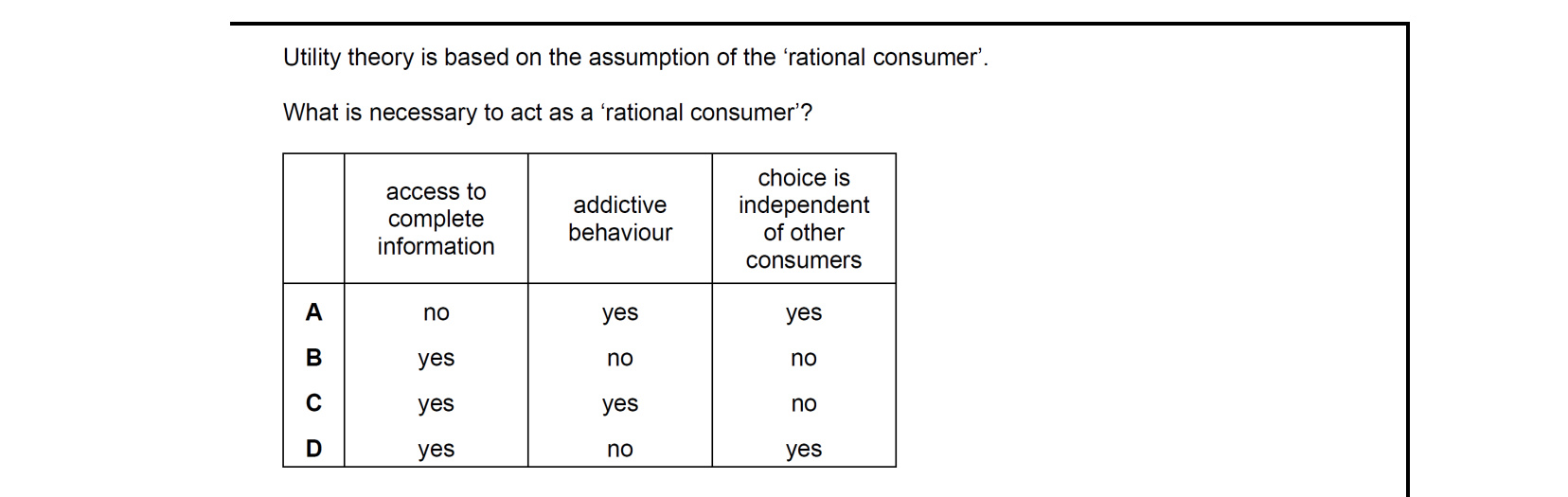
Rationality means the consumer ranks and chooses options to maximise own utility. Choice must therefore not be addictive (otherwise it is not freely made), and the consumer must judge utility for himself, independent of others' behaviour. Goods themselves need not be independent of one another, since substitutes and complements are perfectly compatible with rational choice — so the correct row is yes/no/yes.
End-of-chapter practice
Past-paper questions from CIE 9708. Pick A, B, C or D. Answers are saved on this device — press Download report (PDF) at the top to save them.
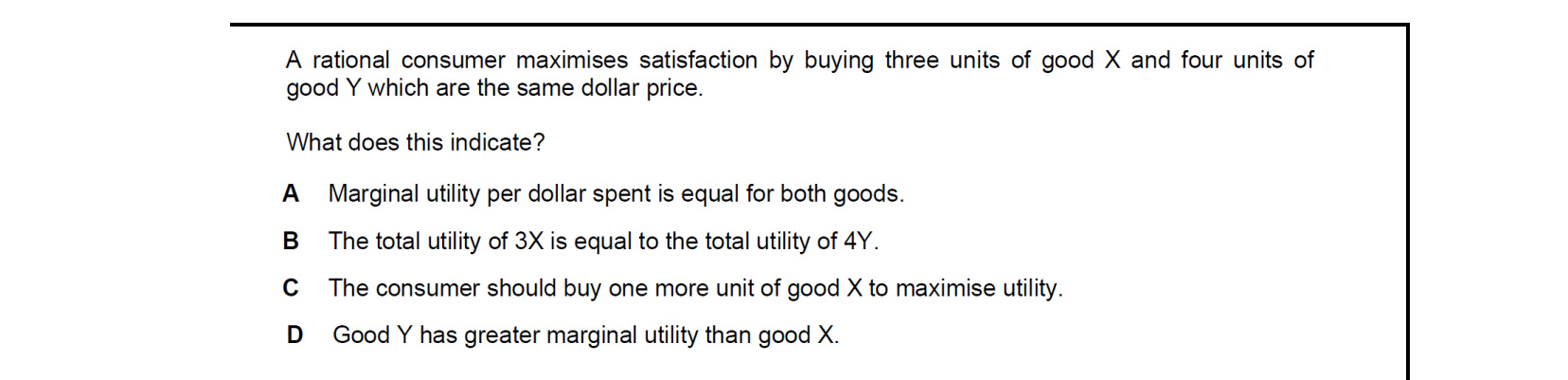
A rational consumer maximises utility where MU per dollar is equal across goods. Since the dollar price of X equals that of Y, equal MU per dollar simply means MU of X equals MU of Y at the chosen quantities. Buying different amounts at the same price is consistent with this only when marginal utility per dollar spent is the same for both goods.
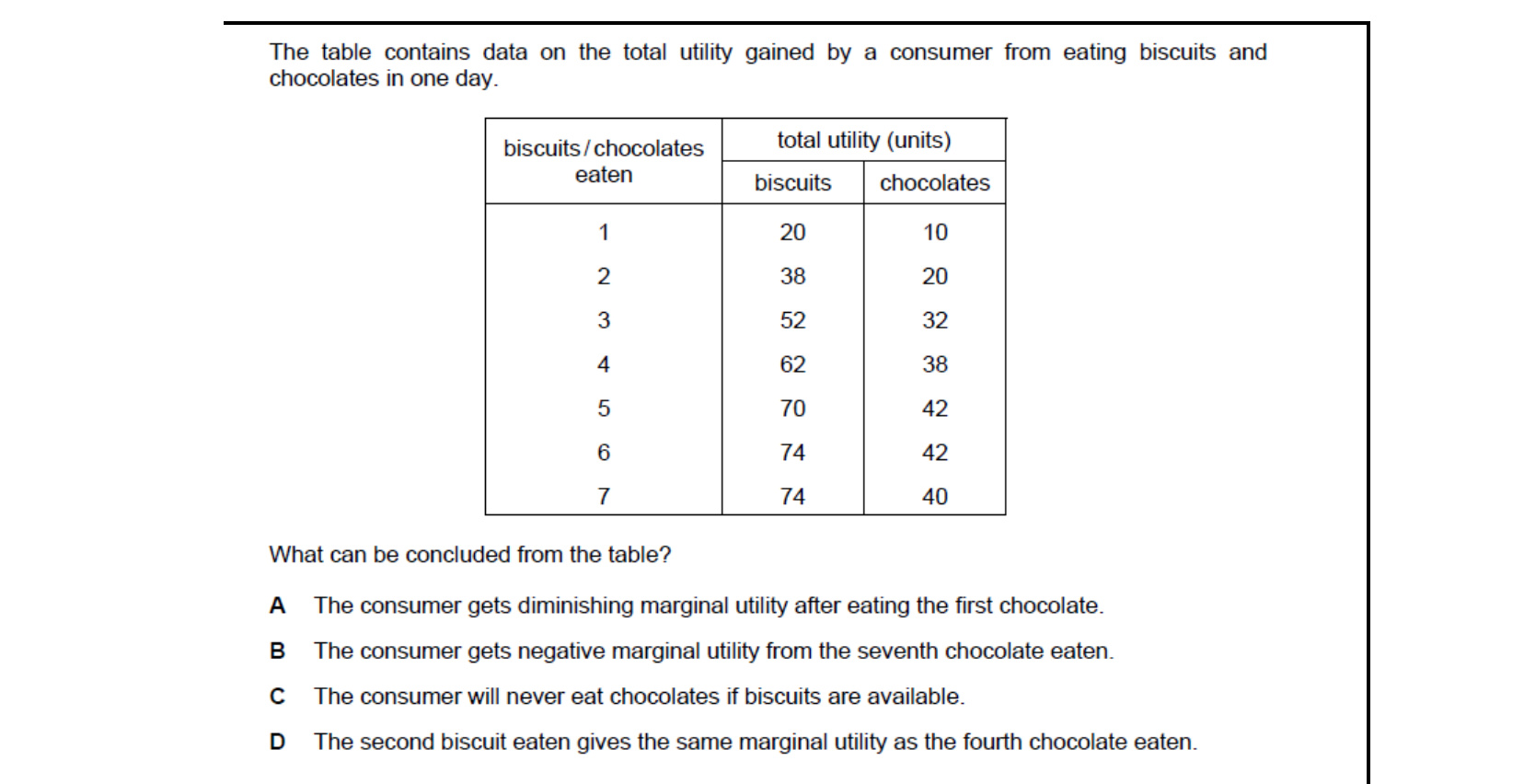
Marginal utility is the change in total utility from one extra unit. From the table, total utility from chocolates rises to 42 at the 5th and 6th chocolate, then falls to 40 at the 7th. The 7th chocolate therefore reduces total utility by 2 — its marginal utility is negative, which is the conclusion that fits the data.
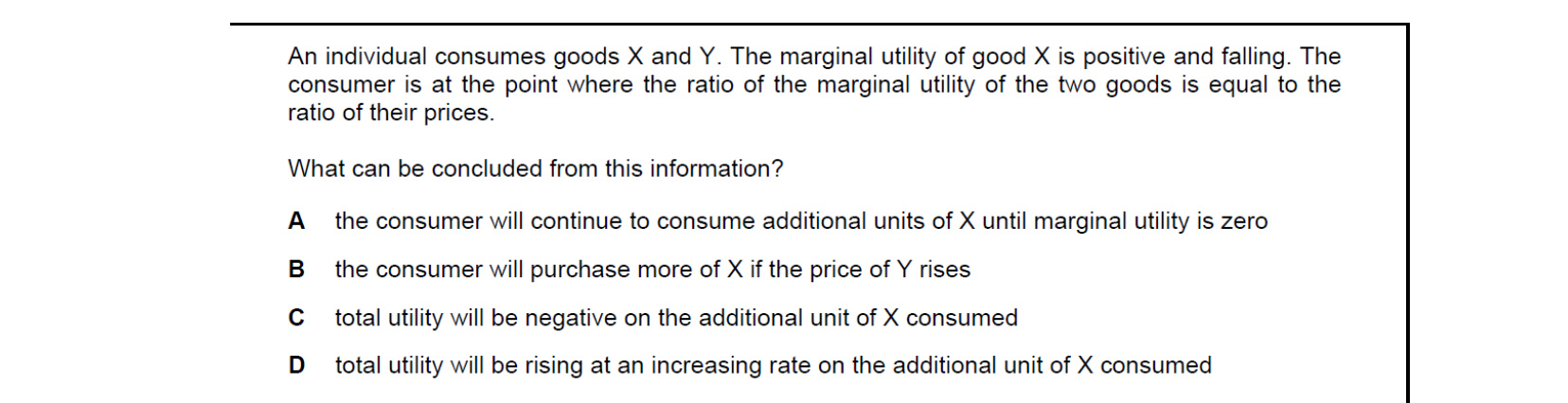
Equilibrium requires MU(X)/P(X) = MU(Y)/P(Y), or MU(X)/MU(Y) = P(X)/P(Y). If the price of Y rises, the price ratio P(X)/P(Y) falls, so MU(X)/MU(Y) must also fall. Since MU of X is positive and falling with consumption, this is achieved by buying more of X — so the consumer will purchase more of X if the price of Y rises.
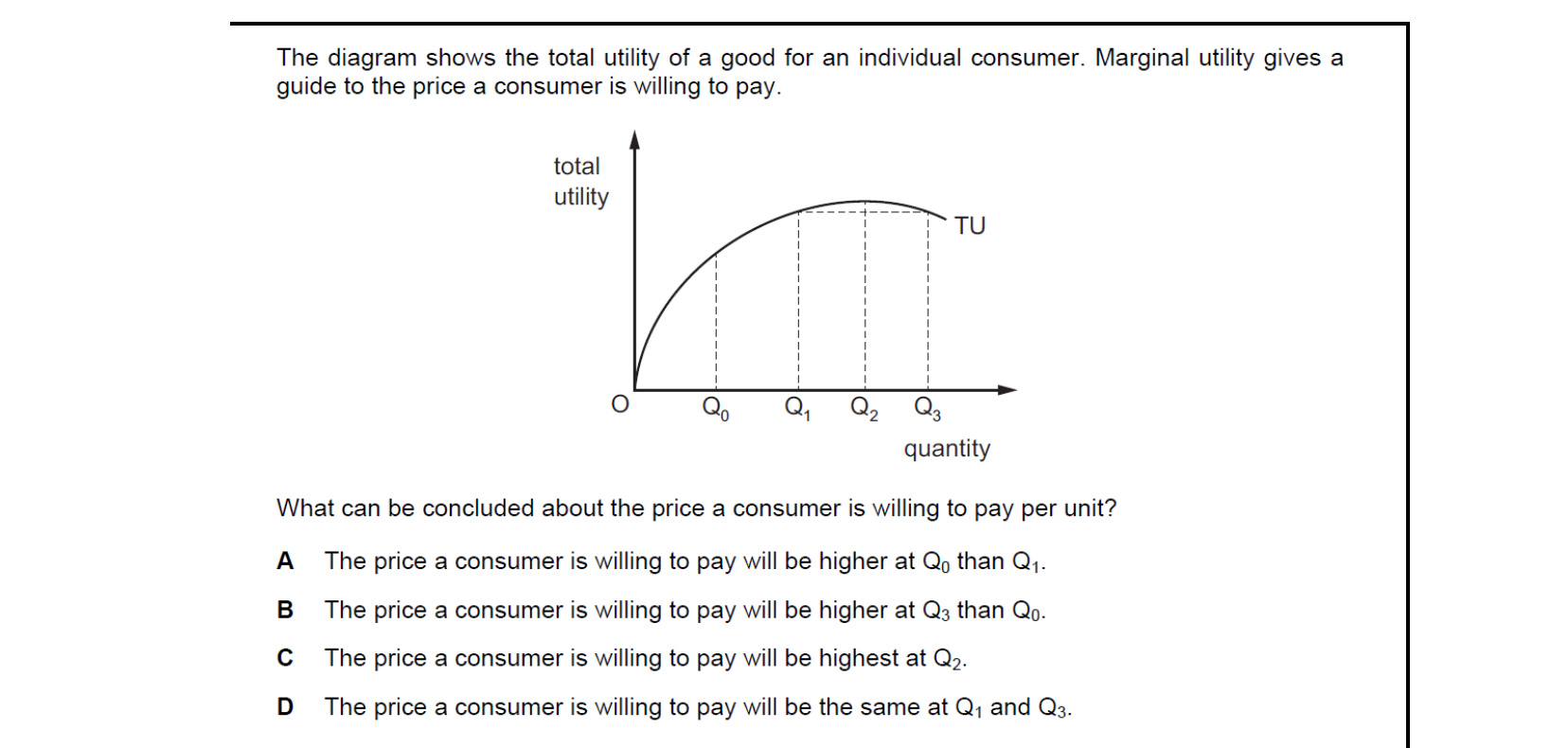
Willingness to pay for the next unit is governed by marginal utility, which is the slope of the total utility curve. Where TU is steepest, MU is highest, so willingness to pay is greatest. The diagram has the steepest slope at the lowest quantity, Q0, so the price the consumer is willing to pay per unit is highest at Q0.
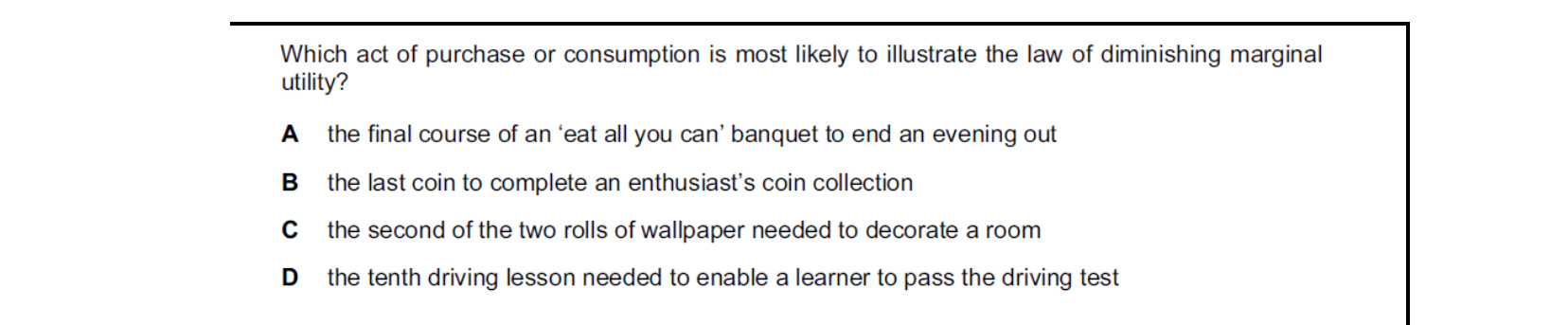
Diminishing marginal utility shows itself most clearly when extra units yield rapidly falling satisfaction. The final course of an 'eat all you can' banquet is the textbook case — earlier courses gave high satisfaction but the last delivers very little extra, and might even cause discomfort. The other examples each represent the unit that completes a needed task, so their marginal utility is high.
Attempt the practice questions above to build your score.
Self-evaluation checklist
After studying this chapter, you should be able to:
- Understand that total utility is the overall satisfaction that is derived from the consumption of all units of a good over a given time period and that marginal utility is the additional utility derived from the consumption of one more unit of a particular good.
- Calculate total utility and marginal utility.
- Explain the equi-marginal principle whereby consumers maximise their utility where their marginal valuation for each product consumed is the same.
- Use the equi-marginal principle to derive an individual demand curve.
- Evaluate the limitations of marginal utility theory and understand that consumers do not always behave as prescribed by utility theory.
Want more practice? Drill this chapter's past-paper MCQs (52 questions) →